Crews working the township today — sweeps & brickwork around SchaumburgInsured • Own Payroll • Mon–Sat, 7 to 7Call (847) 891-9028
Weathersfield • Sarah's Grove • Timbercrest • Olde Centre
The Farm Families Who Settled This Township Built to Outlast Themselves. We Never Unlearned It.
Before the mall and the tollway, Schaumburg was German farmsteads — and those families raised barns their grandchildren could still use. That patience is the whole trade secret here: brick bedded full, joints renewed before they beg, flues kept honest season after season. One phone line, and the man answering it carries a trowel, Monday through Saturday.
7–7 ×6The line held by a mason, Monday through Saturday
43+Years serving the township's brick and flues
5400+Chimneys looked over, swept or raised anew
$149The guild record, written only on commission
The Grange Book
Eight Entries in the Book, Each in Our Own Hand
Every entry below is worked by men this firm pays, trained and answers for. The figure you're quoted gets entered before the work does, and the entry doesn't change afterward.
Sweeping to the Grange Standard
Rotary line or rods as the flue dictates, worked the full run until the scope confirms clean liner — followed by the old-fashioned part, where the smoke shelf and damper meet a hand brush.
The pre-winter pass the old township never skipped: the whole chimney weighed by an experienced eye, mortar age included, and judged out loud. No toll on the looking, ever.
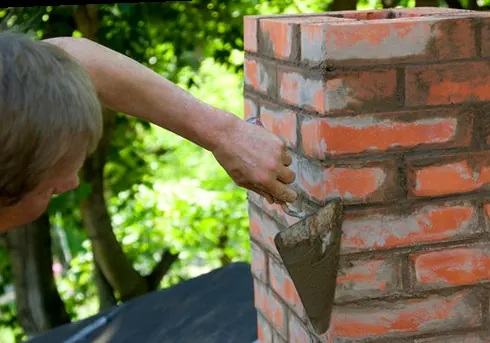
A stack past mending comes down to brick that still deserves trust, then goes back up the barn-raising way — nothing hollow, nothing hurried, a crown over it built for the next generation's fires.
Tired joints cut out to solid bedding, then refilled with a mortar mixed to match the wall it's joining — strength, shade and profile all three — so the repair ages in step with its neighbors.
The wind that once turned this township's windmills now tests its chimney caps. Ours are stainless, screened against sparks and squirrels, and anchored so the gusts find nothing to argue with.
Where roof planes meet brick, water probes every fold. We find the true way in before touching metal, then work new step and counter pieces into the joints until the seam turns weather like a barn roof.
For cracked tile, open joints, or the orphaned water-heater flue the furnace upgrade left behind — one continuous stainless run, lowered plumb, sized to its appliance, insulated where the rules say.
A hearth should obey like good equipment: firebrick reset where heat walked it loose, the smoke chamber made fair so the pull comes even, the damper persuaded back to a clean, quiet swing.
Six days a week, a mason on this lineMetal gone this far quit sealing a while ago and has been feeding the framing since. Tell the man who answers what you see — he holds this line six days a week, 7 to 7 — and the seriousness gets settled inside that same call. The recorder keeps Sunday's messages first in line.
The Rotation
Four Seasons of Work, Turned in Strict Order
A farm that skipped steps went hungry; a trade that skips steps sends surprise invoices. This one does neither — the rotation below never varies.
1
Call the Grange
A working mason answers, 7 to 7, six days. Say what the chimney's shown you and take a date that fits your week.
2
The Once-Over
The complete examination at no toll, closed out face to face with what was found and what it means.
3
Figures in the Book
Repairs entered line by line, urgent kept separate from advisable, and each figure fixed once you've seen it.
4
The Land Left Clean
Work finished to the grange standard, the ground cleaner than we met it, the warranty entered in the book with a copy in your hand.
Before the Season Turns
The Old Farmers Fixed Roofs in September, Not January. They Were Right.
Winter work costs more, waits longer and fights the weather the whole way — that was true on the farmsteads and it's true on your roofline. An October once-over turns most winter emergencies into autumn appointments, and the looking still costs you nothing at all.
A sampling of the season's harvest — flues restored to clean draw, joints renewed, caps anchored and hearths made obedient across the township.
Flue brought back clean — WeathersfieldJoints renewed — Sarah's GroveCrowned and capped — TimbercrestSeam refitted — Hoffman EstatesOnce-over passed — Olde CentreBlight cut out — Rolling MeadowsLiner path proven — PalatineRaised barn-square — RoselleHearth to heel — StreamwoodCrown dressed fair — Elk Grove Village
The Township
The Old Township Bounds, and a Fair Way Past Them
The grange works off Hammond Dr by Woodfield; the trucks cover Schaumburg's neighborhoods and every town that borders them.
Weathersfield
Timbercrest
Sarah's Grove
Lexington Fields
Olde Schaumburg Centre
Town Square
Hoffman Estates
Palatine
Rolling Meadows
Elk Grove Village
Roselle
Hanover Park
Streamwood
Bartlett
Itasca
Bloomingdale
Past the fence rows? Call (847) 891-9028 — the wagons range farther than the sign says.
Over the Gate
What Neighbors Ask Before They Book
Nothing for a full inspection? Say more.
Gladly, because it's simple. A mason — the kind who lays brick for a living, not a salesman with a clipboard — goes over the firebox with its throat and damper, runs the flue from hearth to cap, and finishes on the weather side with the crown, the cap, the flashing and the exposed courses. Then he stands in your driveway and tells you what he found, in words your neighbor would use. For that you owe nothing: your coin stays home. Money enters only if you commission the guild record — the same findings put on paper with photographs and every repair priced by line, $149 — or approve repair work whose figures you saw first. Refuse both and part friends; it happens every week.
And when the flue misbehaves on the one day you're closed?
Sunday, the recorder minds the gate — that's the plain truth of it, and we'd rather post it than pretend otherwise. The other six days a mason takes this line himself, from 7 in the morning till 7 in the evening, and whatever the recorder gathered on Sunday gets the first calls back Monday. But hear the one rule that outranks the schedule: fire showing where fire has no business, or the least suspicion of carbon monoxide, and you empty the house first and give 911 the first call — ours comes later, once everyone is standing in the yard and counted.
Our subdivision went up around 1975. Are all our chimneys aging out together?
More or less, yes — and it's nothing to panic over, just something to schedule around. Whole stretches of Schaumburg were built in a few furious years, which means whole streets of chimneys share a birthday, and mortar has a working life of roughly fifty to sixty winters before the joints want renewing. When one neighbor starts finding grit in the firebox or flakes in the flowerbed, the rest of the block is usually a few seasons behind. The sensible play is a free once-over before symptoms start: tuckpointing caught early is routine maintenance, while tuckpointing caught late is a rebuild with a bigger number on it.
We replaced the furnace and now the water heater has the old chimney to itself. Does that matter?
It matters more than almost anyone tells you. When a high-efficiency furnace moves to plastic sidewall venting, the water heater is left alone on a masonry flue sized for both appliances — the trade calls it an orphaned flue. Its small exhaust can't warm all that oversized bore, so the moisture in the flue gas condenses on the cold clay, and that condensate is acidic enough to eat tile, mortar and eventually the brick at the top of the stack. The usual signs are damp patches, frost at the crown, and flakes in the attic run. The fix is a properly sized stainless liner — a day's work that spares the whole chimney. If your furnace got upgraded in the last several years, this check belongs on your list, and here it rides along with the free once-over.
How often does a working fireplace need the brushes?
Give it one thorough sweeping per burning season, the way the township farmers serviced equipment: by the calendar, before failure, never after. Late spring or early autumn both suit; the rush hits in October, so the early callers pick their day. A flue that sat quiet since March deserves a look before the first fire regardless — idle chimney tops attract tenants with wings and tails. And the flues serving oil or gas heating equipment keep their own annual date, because what builds in them works silently and shows nothing from the hearth.
The home inspector flagged our chimney mid-sale. How fast can this move?
Inside your deadline, if you call this week. The free once-over gets slotted within days; a camera run down the flue settles what the inspector could only glimpse from a ladder; and when the negotiation needs something to hold, the $149 guild record delivers it — findings in writing, photographs attached, every repair priced on its own line. A vague chimney paragraph in an inspection report shrinks fast once a specific number is sitting across the table from it.
Who climbs the ladder, and what's behind them if something goes wrong?
Our own men, on our own payroll — nobody rented by the weekend, nobody met for the first time that morning. Each cleared a background check before his first call, and the firm's general liability and workers' compensation cover every hour of every visit. Ask when you book and the insurance certificate arrives ahead of the crew. That paper is the difference between a tradesman and a stranger with a ladder, and out here we'd advise never settling for the second kind.
Will the sweeping leave its mark on my carpets?
Not in this company's book. Floor covering runs the whole path from door to hearth, the fireplace opening gets sheeted over, and a HEPA vacuum holds the flue under suction the entire time a brush is moving, so every ounce of soot has exactly one destination. An ordinary flue takes near an hour. When the kit is loaded back on the truck, the room should read exactly as we found it — except the chimney draws properly now.
The Hammond Dr Grange
One Line In. A Trowel Hand on It. Six Days of Every Week.
No forms to fill, no queue music, no promises of somebody circling back. The man on this line reads jobs for a living: tell him what you've got and he'll tell you what it likely needs, what it likely runs, and which day he can come prove it.
The grange2330 N Hammond Dr, Suite 102 Schaumburg, IL 60173
The roundsSchaumburg entire, and each town sharing its fence line
When the grange answers
Mon – Sat
Seven to seven by a mason's own hand
Sunday
The gate rests — the recorder holds your turn
A trowel hand holds this line
Tell It Like You'd Tell a Neighbor Over the Fence.
The fire that smoked out the den, the grit behind the andirons, the streak creeping down from the roof — plain words are plenty. What returns is a fair reading, a plain answer on whether we should come out, and a figure that behaves itself all the way to the invoice.